
Royalty Knockout 2026 Match #1
Healthcare Showdown

For new readers, the Knockouts and Madness series pit stocks head-to-head in a knockout series to whittle the field down to top candidates. There are usually no hard and fast criteria, though there is always a weighted factor that also serves for tiebreakers. In the first Silver Madness, the goal was finding the best charts poised for imminent breakouts. If two miners had similar prospects, but one had a chart nearing a completed breakout or starting one, it earned the advantage.
For the royalties, the charts will factor in, but these are also complex entities with extensive assets in some cases running past 100 properties in their portfolio. Holding assets with the potential to payout down the road may not be reflected in the share price. It usually isn’t outside of mania periods.
Another change this time was no random seeing. The largest royalty firms earned byes in the first round.
On to the first matchup.
Xoma Royalty XOMA Ligand LGND vs DRI Healthcare DHT.UN
DRI Healthcare
DRI buys royalties on pharmaceuticals with patent protection, market leadership and high demand. In short, it buys higher-quality assets with existing cash flow. The portfolio is here.

Their top royalty asset is Orserdu, purchased for $85 million in 2023.
Orserdu™ is an oral, selective estrogen receptor degrader (“SERD”) discovered by Eisai and marketed by Stemline Therapeutics, Inc., a subsidiary of the Menarini Group. It is the first and only approved targeted therapy used in the treatment of postmenopausal women or adult men with ESR1-mutated ER+/HER2- metastatic breast cancer, who have experienced disease progression despite prior endocrine therapy. Orserdu™ was approved by the U.S. Food and Drug Administration in January 2023 and is under review by the European Medicines Agency for potential approval.
They’ve almost earned back the entire purchase price via cash payments to this point and the drug is under patent protection until 2038. A win by any measure.
A significant recent asset it Ekterly. The spend for this one could hit $179 million if milestones and other payments kick in. They’ve paid $100 million up-front. Conservatively, it might eventually generate in the region of $300 million for the firm. There’s a limit to the upside because the royalty of 6 percent on initial sales declines as sales rise, collapsing to just 0.25 percent after $750 million in sales. Not in royalty payments.
DRI is mostly buying known quantities with potential upside, but it’s not looking for diamonds in the rough like the gold mining royalty firms paying $1 million for the possibility that a hole in the ground will become a mine in 10 or 20 years.
The main flag, call it yellow instead of red, is the use of debt financing. The larger flag is that it’s a Canadian trust, which creates headaches for foreign investors. That alone is going to be a major hurdle.
Ligand Pharmaceuticals
XOMA was to be the entry, but Ligand is buying it for cash.
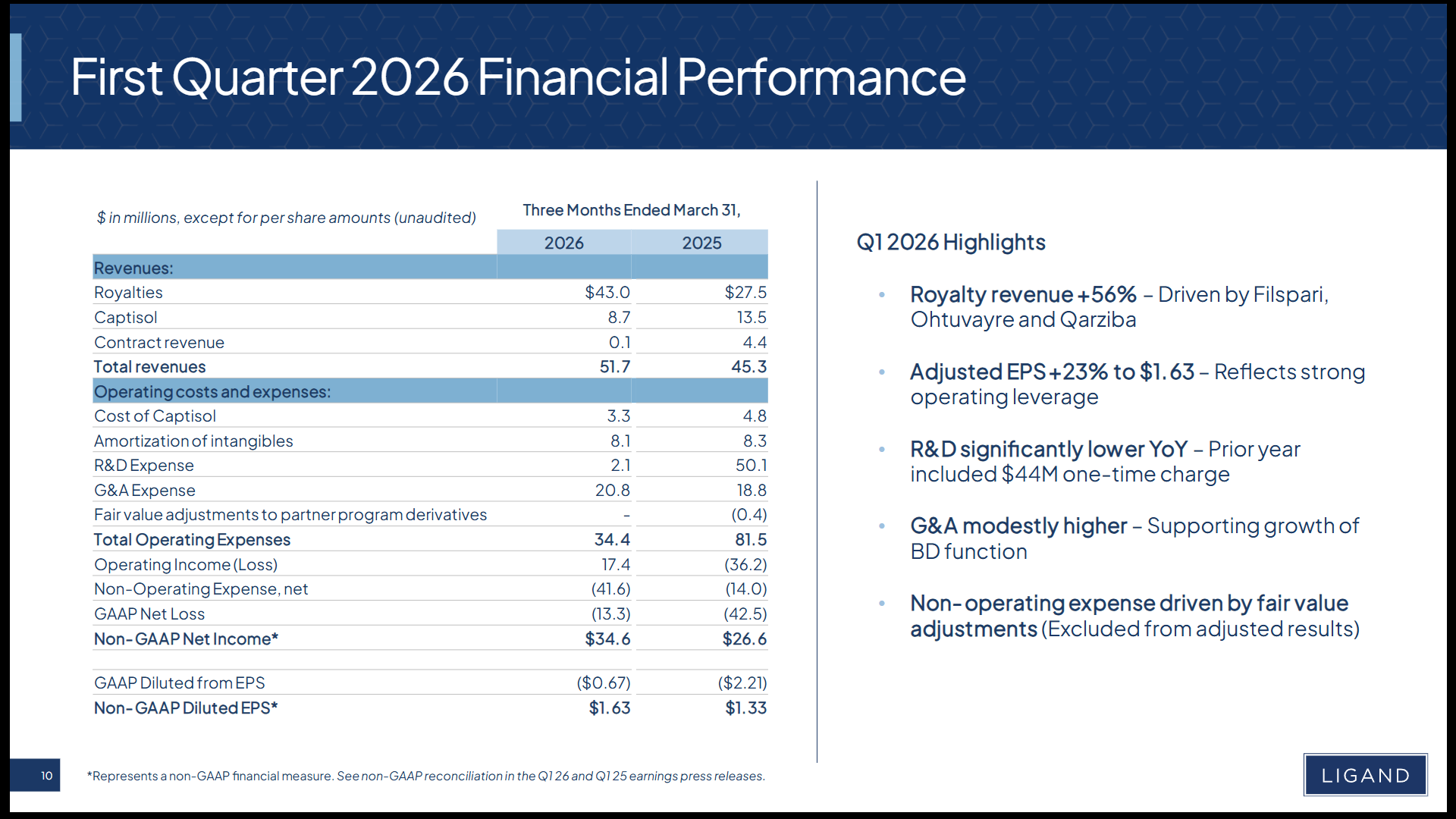
Ligand is about 7x the side of DRI, a US$5 billion royalty firm. The company changed its model in 2007 and after plummeting in the bear market, went on an incredible run. The biggest strike against the firm is that it sits at the potential tail end of a massive run, perhaps a double top with significant downside risk.

Ligand acquires royalties, finances in the development stage (taking on more risk than DRI) and buys companies with royalty assets such as XOMA.
Last year, Ligand was roughly 60 percent royalties, 20 percent IP platform Captisol and 20 percent contract revenue. Capitsol is a patent-modified cyclodextrin used in pharmaceutical formulations to make water-insoluble drugs soluble and stable. This product generates revenue for the firm including fees and licensing. An investment presentation is available on their website. A list of their royalties is found here.
After acquiring XOMA, Ligand will have north of 200 royalties on its books.
Current top asset is the Filspari royalty, generating about 20 percent of its royalty revenue.
Royalty firms are known for being lumpy and relying on a few key assets. Ligand is no exception, but it’s done a good job of diversification. The main knock at this point is the price-to-earnings of 35 times earnings. The firm has earned itself a premium and the stock price reflects a full valuation of the firm.
Results
If DRI was listed in the United States, it would be the better buy at this stage. For a Canadian investor, DRI looks solid. One major accretive deal could re-rate the stock to a new higher valuation. If royalty revenues hold up, the stock is trading at a discounted P/E ratio. The chart history is short, impossible to make a call here. On balance, I’d be more comfortable owning DRI at this very moment, but I don’t want to buy a Canadian PFIC.
Downside risk in LGND is a concern. It’s not a great buying opportunity. Upside is about $500 on a breakout. If this stock was about 25 percent cheaper, around $180, it would be a fairer valuation. Should downside risk materialize, it could work its way all the way to $100 per share. At that point, assuming the risk was mainly macro and market related, and not company-specific problems, it would represent an excellent value. At $100 per share, one might pencil in a 10x over the coming 10 to 20 years if the underlying business outlook was the same. Sometimes bear markets come bearing gifts.
There are no plans to add a dividend and given it’s size, it’s defensible that they stick with growing the firm and doing buybacks.
Final call: LGND moves on for being a large, successful compounder with a growing portfolio of royalty assets in addition to two other business lines deliver significant revenue. It doesn’t pass on a valuation call or on a chart call unless it were to breakout to the upside.
DRI’s main strike is the Canadian trust listing and accompanying headaches for U.S. investors. For Canadian investors, DRI would be the winner.